

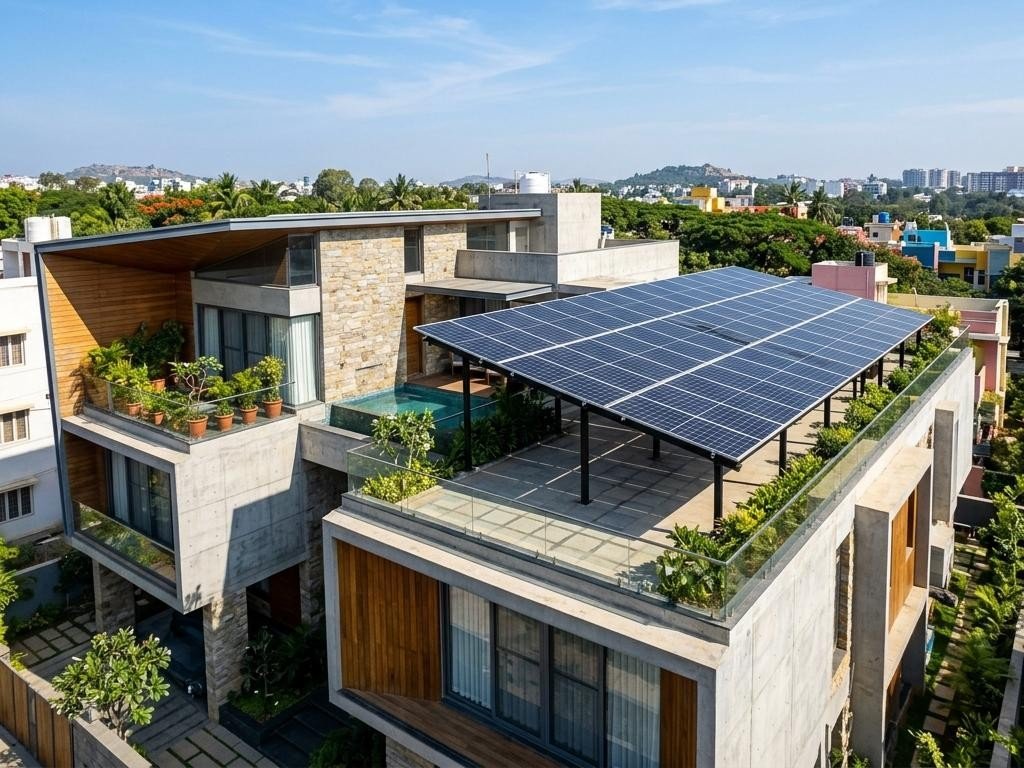
Reduce Your Electricity Bills with On-Grid Solar Systems
Power Your Home with Clean and Affordable Solar Energy
An on-grid solar system is one of the most cost-effective ways to generate electricity for your home or business. Connected directly to the electricity grid, it allows you to use solar power during the day and export excess electricity to the grid through an approved net-metering arrangement.
At Sarita Adidev Ventures, we provide customized rooftop solar solutions designed around your electricity consumption, available rooftop space and energy requirements.
Our goal is to help you reduce electricity expenses while making the transition to renewable energy simple and convenient.
WHAT IS AN ON-GRID SOLAR SYSTEM?
Understanding Grid-Connected Solar Power Systems
An on-grid solar system, also known as a grid-tied solar system, is a rooftop solar installation connected to the main electricity grid.
Solar panels capture sunlight and convert it into DC electricity. A solar inverter then converts this electricity into AC power that can be used by your home or business.
When your solar system generates more electricity than you consume, the excess energy can be exported to the electricity grid, subject to local DISCOM approval and net-metering regulations.
When solar generation is insufficient, your property draws the required electricity from the grid.
Key Features of an On-Grid Solar System:
Generates electricity using sunlight.
Reduces monthly electricity bills.
Supports net metering where permitted.
Does not require batteries in a standard configuration.
Helps reduce dependence on conventional electricity.
Provides an economical long-term solar solution.
HOW DOES AN ON-GRID SOLAR SYSTEM WORK?
From Sunlight to Electricity – A Simple Process
An on-grid solar system works through a combination of solar panels, an inverter and a grid connection.
Step 1: Solar Energy Generation
Solar panels installed on your rooftop capture sunlight and convert it into direct current (DC) electricity.
Step 2: DC to AC Conversion
The solar inverter converts the generated DC electricity into alternating current (AC), making it suitable for household and commercial appliances.
Step 3: Powering Your Property
The generated solar electricity is used to operate appliances such as lights, fans, refrigerators, computers and other electrical equipment.
Step 4: Exporting Excess Electricity
If your solar system produces more electricity than your property consumes, the surplus electricity can be sent to the grid through an approved net-metering connection.
Step 5: Drawing Electricity from the Grid
During nighttime or periods of low solar generation, your property receives electricity from the utility grid.
MAIN COMPONENTS SECTION
Essential Components of an On-Grid Solar System
A reliable solar installation requires several components working together efficiently.
1. Solar Panels
Solar panels absorb sunlight and convert it into DC electricity. Their capacity and efficiency determine how much solar energy your system can generate.
2. On-Grid Solar Inverter
The inverter converts DC electricity generated by the solar panels into usable AC electricity and synchronizes the system with the utility grid.
3. Mounting Structures
These structures securely support solar panels on your rooftop while maintaining the required orientation and tilt.
4. Electrical Cables and Connectors
High-quality AC and DC cables, MC4 connectors and other accessories ensure proper electrical connections throughout the installation.
5. Protection and Safety Equipment
Earthing, surge protection and suitable electrical protection devices help safeguard the solar installation against electrical faults and voltage surges.
6. Net Meter
A bidirectional meter records electricity imported from and exported to the grid according to applicable net-metering regulations.
BENEFITS SECTION
Why Choose an On-Grid Solar System?
Installing an on-grid solar system offers several financial and environmental benefits.
1. Lower Electricity Bills
Generate your own electricity and reduce the amount of power you purchase from your electricity provider.
2. Long-Term Savings
A properly designed solar system can help you save on electricity expenses over its operating life.
3. Government Subsidy Benefits
Eligible residential consumers may receive financial assistance under the PM Surya Ghar Muft Bijli Yojana, subject to applicable government guidelines.
4. Net Metering Benefits
Export surplus electricity to the grid where net metering is approved, helping you optimize the use of generated solar power.
5. Environment-Friendly Energy
Solar energy is a clean and renewable source of electricity that helps reduce dependence on conventional energy sources.
6. Low Maintenance Requirements
Without a battery bank in a standard on-grid configuration, the system has fewer components requiring maintenance.
7. No Battery Replacement Expenses
A standard on-grid system does not require batteries, eliminating battery replacement costs.
SOLAR SUBSIDY SECTION
Government Solar Subsidy Under PM Surya Ghar Yojana
The Government of India offers Central Financial Assistance (CFA) to eligible residential consumers installing grid-connected rooftop solar systems under the PM Surya Ghar: Muft Bijli Yojana.
The central subsidy structure for eligible residential installations is:
| Solar System Capacity | Central Subsidy |
|---|---|
| 1 kW | ₹30,000 |
| 2 kW | ₹60,000 |
| 3 kW and above | ₹78,000 |
Important Information:
Subsidy is available only to eligible residential consumers.
The installation must comply with applicable scheme guidelines.
Eligible equipment and registered vendor requirements must be fulfilled.
The application and commissioning process must follow the official scheme procedure.
Commercial and industrial installations are not eligible for this residential CFA.
The final subsidy amount and eligibility depend on the applicable government guidelines and DISCOM requirements.
At Sarita Adidev Ventures, we can guide customers through the solar installation and applicable subsidy documentation process.
ON-GRID VS OFF-GRID SOLAR SYSTEM
Which Solar System Is Right for Your Property?
Choosing the right solar system depends on your electricity requirements, grid availability and need for backup power.
| Feature | On-Grid Solar | Off-Grid Solar |
|---|---|---|
| Grid Connection | Required | Not required |
| Battery Storage | Not required | Required |
| Electricity Bill Savings | Yes | Yes |
| Power During Grid Outage | No, standard systems shut down | Yes, subject to battery capacity |
| Net Metering | Available where approved | Not applicable |
| Battery Maintenance | Not required | Required |
| Best For | Properties with reliable grid supply | Areas with unreliable or unavailable grid supply |
Our Recommendation:
Choose an on-grid solar system if your property has a reliable electricity connection and your primary objective is to reduce monthly electricity bills.
If you experience frequent power cuts and require backup electricity, consider a hybrid or off-grid solar solution instead.
INSTALLATION PROCESS SECTION
Our Professional On-Grid Solar Installation Process
At Sarita Adidev Ventures, we follow a systematic approach to make your solar installation smooth and efficient.
Step 1: Initial Consultation
We understand your electricity consumption, monthly electricity bills and solar energy requirements.
Step 2: Rooftop Inspection
Our team assesses your available rooftop space, sunlight exposure, shading and installation requirements.
Step 3: Customized Solar System Design
We recommend a suitable solar system capacity, panel configuration and inverter based on your property’s requirements.
Step 4: Professional Installation
Solar panels, mounting structures, inverters and electrical accessories are installed according to applicable safety and technical standards.
Step 5: Net Metering and Documentation
We guide you through the applicable DISCOM approvals, net-metering requirements and documentation process.
Step 6: Testing and Commissioning
The system is inspected and tested to ensure proper operation before being commissioned.
WHY CHOOSE US SECTION
Why Choose Sarita Adidev Ventures for Solar Installation?
Choosing the right solar partner is just as important as choosing the right solar panels.
At Sarita Adidev Ventures, we focus on providing dependable solar solutions with attention to quality, performance and customer satisfaction.
Customized Solar Solutions
Every property has different electricity requirements. We recommend solar systems based on your actual energy consumption and available rooftop space.
Quality Solar Components
We focus on selecting suitable solar panels, inverters and electrical components for reliable system performance.
Professional Installation
Our installation approach prioritizes proper system design, secure mounting and safe electrical connections.
Subsidy Guidance
We help eligible residential customers understand the government subsidy process and required documentation.
Customer-Focused Support
We aim to provide assistance throughout the solar journey, from the initial consultation to installation and after-sales support.
Long-Term Energy Savings
Our goal is to help customers make a smart investment in renewable energy and reduce their dependence on conventional electricity.
FINAL CTA SECTION
Ready to Switch to Solar Energy?
Take the first step towards lower electricity bills and a cleaner future with Sarita Adidev Ventures.
Whether you are planning a rooftop solar installation for your home or business, our team can help you find the right solution based on your energy requirements.
Get expert guidance, understand your solar options and discover how much you can save with rooftop solar.
Button: Get Your Free Solar Consultation
Secondary Button: Contact Our Team Today
FAQ SECTION
Frequently Asked Questions About On-Grid Solar Systems
1. What is an on-grid solar system?
An on-grid solar system is a rooftop solar installation connected to the main electricity grid. It generates electricity from sunlight and can export surplus power through an approved net-metering arrangement.
2. Does an on-grid solar system require batteries?
No. A standard on-grid solar system does not require battery storage because it works in connection with the electricity grid.
3. Does an on-grid solar system work during a power cut?
No. Standard on-grid inverters automatically shut down during grid failures because of anti-islanding safety protection. A suitable hybrid system with backup capability is needed for electricity during outages.
4. Can I reduce my electricity bill with on-grid solar?
Yes. Solar-generated electricity can reduce the amount of power you purchase from the grid. Actual savings depend on your consumption, solar generation, tariffs and net-metering arrangements.
5. Is government subsidy available for on-grid solar systems?
Eligible residential consumers can receive central financial assistance under the PM Surya Ghar Muft Bijli Yojana, subject to current scheme requirements.
6. How long does an on-grid solar system last?
Solar panels are generally designed for long-term operation, often with a performance warranty of around 25 years or more. Actual lifespan depends on product quality, installation and maintenance.
7. Can I install an on-grid solar system for my business?
Yes. On-grid solar systems can be installed for eligible commercial and industrial properties. System design and approvals depend on the property’s electricity connection and applicable regulations.
8. What maintenance does an on-grid solar system require?
Regular panel cleaning, visual inspection, electrical connection checks and inverter performance monitoring help maintain system efficiency.
9. What is net metering in solar?
Net metering is a billing arrangement that records electricity imported from and exported to the grid. Its availability and billing treatment depend on local DISCOM regulations.
10. How do I choose the right solar system capacity?
The right capacity depends on your monthly electricity consumption, rooftop space, available sunlight and sanctioned electricity load. A professional site assessment helps determine the suitable system size.
SEO INFORMATION
SEO Title: On-Grid Solar System for Home | Benefits, Subsidy & Installation
Meta Description: Install an on-grid solar system with Sarita Adidev Ventures. Reduce electricity bills, explore government solar subsidies and get professional rooftop solar installation.
Focus Keyword: On Grid Solar System
Additional Keywords:
On Grid Solar System for Home
Rooftop Solar Installation
On Grid Solar Panel
Solar Panel Installation
Solar Subsidy in India
Net Metering Solar System
Residential Solar Solutions
Commercial On Grid Solar System