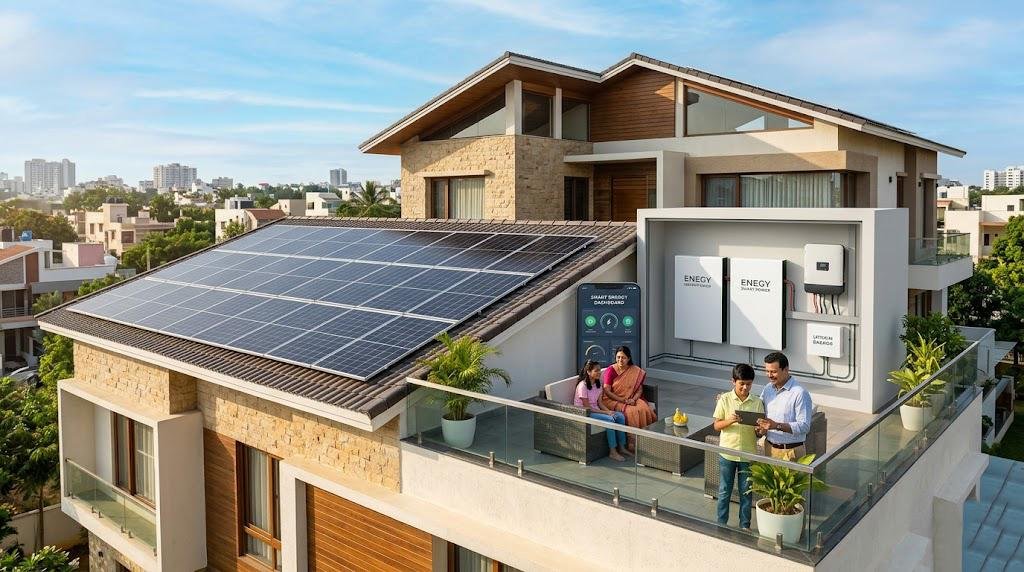
WHAT IS AN OFF-GRID SOLAR SYSTEM?
Small Label: UNDERSTANDING OFF-GRID SOLAR
Your Home. Your Power. Your Energy Independence.
An off-grid solar system is a standalone solar power solution that generates and stores electricity without connecting to the public electricity grid.
It uses solar panels to capture sunlight and convert it into electricity. The generated energy powers your household appliances, while excess electricity is stored in batteries for later use.
During the evening, at night or when sunlight is limited, the stored battery energy can supply electricity to your home.
Unlike on-grid solar systems, an off-grid system does not depend on a grid connection for its normal operation.
It is particularly useful for homes where grid electricity is unavailable or extremely unreliable.
3. HOW DOES AN OFF-GRID SOLAR SYSTEM WORK?
Small Label: SIMPLE WORKING PROCESS
Generate. Store. Use.
An off-grid solar system manages electricity generation and battery storage to supply your home throughout the day.
01. Solar Panels Capture Sunlight
Rooftop solar panels capture sunlight and convert it into direct current (DC) electricity.
02. Solar Inverter Manages Electricity
The solar charge controller regulates battery charging, while the inverter converts electricity into alternating current (AC) for household appliances.
03. Excess Electricity Charges Batteries
Electricity not immediately required by your home can be used to charge the battery bank.
04. Stored Energy Powers Your Home
When sunlight is unavailable, the stored battery energy supplies electricity to your connected household appliances.
4. MAIN COMPONENTS OF AN OFF-GRID SOLAR SYSTEM
Small Label: SYSTEM COMPONENTS
Every Component Has an Important Role
An off-grid solar installation combines different components to generate, store and distribute electricity safely.
Solar Panels
Capture sunlight and convert solar energy into DC electricity.
Solar Inverter
Converts DC electricity into AC electricity that household appliances can use.
Battery Storage
Stores available solar electricity for use during the evening, night and periods of low sunlight.
Solar Charge Controller
Regulates the electricity flowing from solar panels to the batteries and helps protect them from improper charging.
Mounting Structures
Provide secure support for rooftop solar panels and help position them for effective sunlight exposure.
Electrical Protection and Accessories
Include suitable cables, connectors, earthing and protection equipment to support safe system operation.
5. BENEFITS OF AN OFF-GRID SOLAR SYSTEM
Small Label: WHY CHOOSE OFF-GRID SOLAR?
Greater Control Over Your Electricity
An off-grid solar system can be a practical solution for homes that cannot depend on regular grid electricity.
Power Without a Grid Connection
Generate and use electricity independently of the public electricity grid.
Battery Backup
Use stored solar energy to power connected appliances when sunlight is unavailable.
Solar Energy Day and Night
Generate electricity during daylight hours and use stored energy later.
Reduced Grid Dependence
Operate your household using your own solar generation and battery storage.
Cleaner Energy Source
Generate electricity from sunlight without direct fuel combustion during normal solar operation.
Customised Energy Planning
Choose solar and battery capacity according to your household electricity requirements.
6. IS AN OFF-GRID SOLAR SYSTEM RIGHT FOR YOUR HOME?
Small Label: FIND YOUR SOLAR SOLUTION
Choose Independence When the Grid Is Not Enough
An off-grid solar system may be suitable for your home if:
Your property does not have access to a reliable electricity connection.
You experience frequent and prolonged power cuts.
You want to operate your home independently of the electricity grid.
You need battery storage for essential household appliances.
You have sufficient shadow-free rooftop space for solar panels.
Before You Decide
An off-grid system requires carefully planned battery storage. The battery must be capable of supporting your connected appliances during periods when solar generation is low.
It also generally involves a higher initial investment than a standard on-grid system because battery storage and additional equipment are required.
If your home already has a reliable grid connection and your primary objective is reducing electricity bills, an on-grid solar system may be a more economical choice.
7. HOW DO WE DESIGN THE RIGHT OFF-GRID SOLAR SYSTEM?
Small Label: SMART SYSTEM PLANNING
Designed Around Your Daily Electricity Needs
The right off-grid solar system is not selected by panel capacity alone. Solar generation, inverter capacity and battery storage must work together.
Household Electricity Consumption
We assess how much electricity your household uses every day.
Appliance Requirements
We identify which appliances need to operate together and their starting power requirements.
Solar Panel Capacity
We consider your electricity consumption, available rooftop area and expected sunlight conditions.
Battery Storage Capacity
We estimate the storage required to support your household during nighttime and periods of low solar generation.
Backup Duration
We discuss how long your essential appliances should operate using stored battery energy.
This planning helps us recommend a system that matches your actual household requirements.
8. OFF-GRID VS ON-GRID VS HYBRID SOLAR SYSTEM
Small Label: COMPARE SOLAR SOLUTIONS
Understand the Difference Before Choosing
Each solar system serves a different household requirement.
| Feature | On-Grid | Hybrid | Off-Grid |
|---|
| Grid Connection | Yes | Yes | No |
| Battery Required | No | Yes | Yes |
| Power Cut Backup | No | Yes | Yes |
| Stores Solar Energy | No | Yes | Yes |
| Uses Grid Electricity | Yes | Yes | No |
| Main Purpose | Bill Savings | Savings + Backup | Energy Independence |
Which One Should You Choose?
Choose on-grid solar for electricity bill savings when grid supply is reliable.
Choose hybrid solar when you want solar savings with battery backup.
Choose off-grid solar when you need an independent electricity system without relying on a public grid connection.
9. OFF-GRID SOLAR SYSTEM SUBSIDY
Small Label: IMPORTANT SUBSIDY INFORMATION
Know the Applicable Government Benefits
The PM Surya Ghar Muft Bijli Yojana provides central financial assistance for eligible residential grid-connected rooftop solar systems.
However, standalone off-grid solar systems are not eligible for central subsidy under this scheme because they are not connected to the electricity grid.
If receiving the PM Surya Ghar central subsidy is important to you, an eligible grid-connected on-grid or approved hybrid configuration may be a better option.
Our team can help you understand the available solar solutions and applicable subsidy requirements.
For official scheme information, visit:
https://pmsuryaghar.gov.in/
10. OUR OFF-GRID SOLAR INSTALLATION PROCESS
Small Label: SIMPLE AND TRANSPARENT PROCESS
From Your Rooftop to Your Solar Power System
We take care of the important steps involved in your solar installation.
01. Free Site Survey
We assess your rooftop, household electricity consumption and installation requirements.
02. Custom System Design
We plan the solar panels, inverter and battery capacity according to your needs.
03. Professional Installation
Our team installs the solar panels, mounting structures, inverter, batteries and required electrical connections.
04. System Testing and Commissioning
We check the installed system and its operation before handover.
05. After-Sales Support
We provide service support after installation to help you with your solar system.
11. FREQUENTLY ASKED QUESTIONS
Small Label: HAVE QUESTIONS?
Off-Grid Solar System FAQs
1. What is an off-grid solar system?
An off-grid solar system is a standalone solar installation that generates and stores electricity without connecting to the public electricity grid.
2. Can an off-grid solar system run a home at night?
Yes. The system uses electricity stored in its batteries during the day to power connected appliances at night. Backup duration depends on battery capacity and household consumption.
3. How many batteries are required for an off-grid solar system?
The number of batteries depends on your daily electricity consumption, required backup duration, battery capacity and inverter specifications. A proper assessment is needed before deciding.
4. Is government subsidy available for off-grid solar systems?
Standalone off-grid systems are not eligible for central subsidy under the PM Surya Ghar Muft Bijli Yojana, which applies to eligible grid-connected residential rooftop solar installations.
5. Can I run an air conditioner with an off-grid solar system?
Yes, provided the solar system, inverter and battery bank are appropriately sized for the air conditioner’s running power and starting requirements. The final design depends on the appliance specifications and usage duration.
12. FINAL CALL TO ACTION
Small Label: TAKE CONTROL OF YOUR ENERGY
Ready for Independent Solar Power?
Make Your Home Solar Powered.
Get a solar solution designed around your household electricity requirements. Our team will help you understand the right system capacity, battery storage and installation requirements.
Book your free site survey today and take the first step towards greater energy independence.
Button: Book Your Free Site Survey
Call Us: +91 83539 62356
Email: saritaadidevventures@gmail.com